A Fresh Look at the MFT Format!
For years now the Micro Four Thirds (MFT) sensor has been compared to the Full Frame sensor as if it were inferior and limited in its utility. This notion is ignorant and false. In my world – that of a feature film cinematographer, I’ve always found that a closer and more interesting comparison of the MFT format should be made with a standard four perf film camera and the most utilized aspect ratio in film history – 1.85:1. By far the most popular cinema format, the 1.85 aspect ratio has framed multiple thousands, (est. 100,000) of motion pictures. So, I ask, why not compare the MFT format to this durable workhorse in our industry?
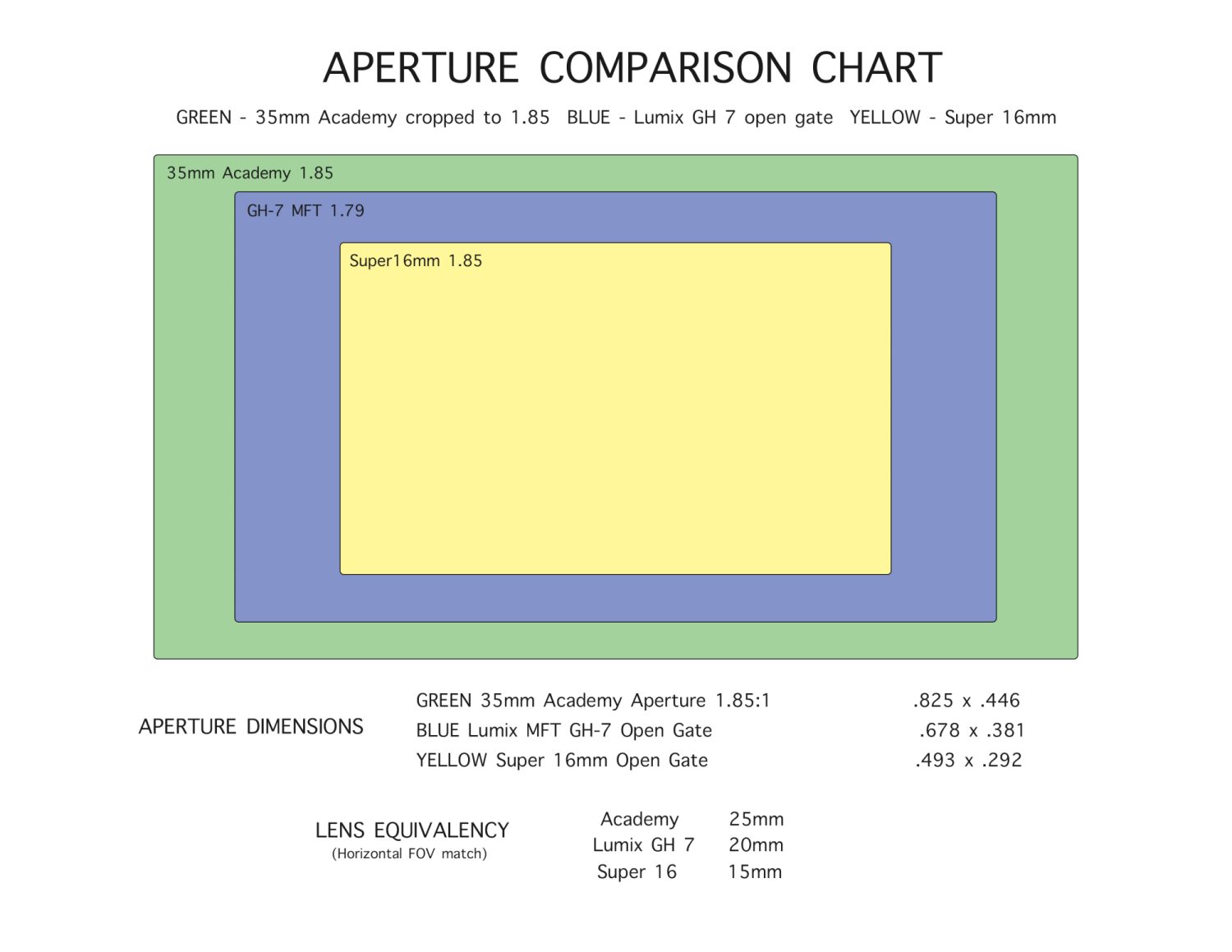
As you can see the comparison has been made in the above graphic.
I guess anyone’s first takeaway is that the MFT aperture is only 20% smaller than it’s 35mm film cousin. Size aside, given the control and processing options we have over digital images; one could make a strong case that the MFT image would compare favorably to that of a 1.85 image captured on film, if using the same lens under similar lighting conditions.
A Lumix GH-7 in OPEN GATE can produce a 5.7K image that can be captured via Apple ProRes RAW or the ARRI C3 color space and many other common codecs. With ProRes RAW, the footage is first rate, but the files are quite large, though tiny in comparison to a Full Frame rendering with the same setting.
I have been a part of the MFT scene for years now and know the difference between the two formats having shot VistaVision plates at ILM. Today’s full frame sensor is virtually equal to the 8 perf VistaVision aperture that dimensionally produces a 1.50:1 image. However, for our Visual FX shots, we extracted a 2.40:1 slice from the full frame because we were compositing to a 35mm anamorphic internegative on an optical printer. In other words, we reduced an 8 perf extracted 2.40 spherical image to a 4 perf anamorphic one. If you own a camera with a F Frame sensor and have chosen to shoot in spherical 2.40:1 that “crop” (extraction) is exactly the same as we performed daily at ILM.
With the GH-7 in Open Gate, the 16/9 footage is un-cropped!
I’m not sure why some people scoff at the notion that the MFT format can produce cinema quality work because in my opinion, experience and definition - it can. Besides, the entire system is smaller, lighter and less expensive than its larger counterpart. Yes, because of the sensors smaller circle of confusion, the MFT user is denied a super shallow depth of field which is desirable to many, including myself. But I feel the overall lens quality is far superior given the area it needs to cover. In fact, the MFT cinema lenses I have are designed to cover an APSC sensor but are rehoused for the MFT format and thus the imaging occurs in the center, or best part of the optical elements.

